Who Really Drives Innovation?
Inside the ecosystem that turns ideas into impact. Innovation doesn't happen in isolation — it emerges when people, policy, capital, institutions, and culture align.

Innovation doesn't happen in isolation. It is not the product of visionary individuals with grandiose ambitions. It emerges when people, policy, capital, institutions, and culture align. There is a common belief that you have to break the system to build something new, yet disruption without alignment rarely scales. It is when the different parts of an ecosystem are working together that innovation gains real momentum. What often determines whether that happens is something less visible: reliable leadership, an interlocutor that can coordinate across the system, understand the real-world frictions standing between ideas and impact, and bridge what often feels disconnected.
There is a common belief that you have to break the system to build something new, yet disruption without alignment rarely scales. It is when the different parts of an ecosystem are working together that innovation gains real momentum. What often determines whether that happens is something less visible: reliable leadership, an interlocutor that can coordinate across the system, understand the real-world frictions standing between ideas and impact, and bridge what often feels disconnected.
 What an Innovation Ecosystem Really Is
To understand innovation, you need to understand it not as a moment of genius, but as a continuous dynamic process that is shaped by the alignment of several components. This is the innovation ecosystem, a designed system that allows different actors and sectors to interact and reinforce each other. When these elements are aligned and mutually supportive, innovation thrives. Hub71 in Abu Dhabi is a good example of such a system, developed by the UAE government to attract and nurture new impactful ideas. Without an ecosystem like Hub71, innovation often remains as it began, simply an idea. These ecosystems do not always emerge organically.

Ideas are the easy part. The real challenge is managing what can be called "innovation friction": the invisible systemic barriers that trap promising concepts before they ever reach society. These include murky intellectual property laws, rigid regulations, and a cultural reluctance to tolerate failure. If governance is weak or the regulatory path is unclear, the entire engine of innovation stalls, regardless of how strong the initial concept is.
Saudi Arabia’s Vision 2030 provides a clear example of addressing this friction directly. By overhauling its intellectual property framework, the government proactively removed a major source of investor hesitation. This move provided the regulatory credibility needed to attract global capital and move ideas out of the abstract and into the market. Ultimately, turning an idea into a true innovation requires an environment that actively manages these hidden variables effectively.
Mapping the Key Players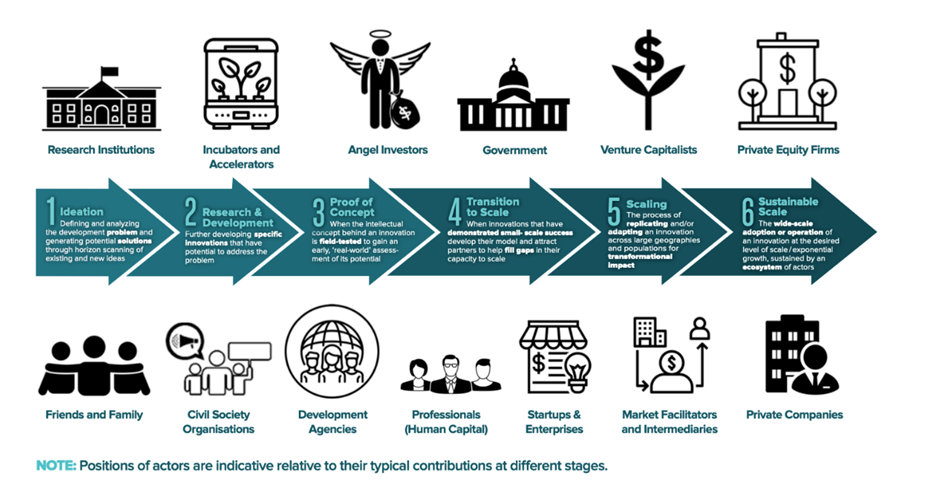
Every innovation ecosystem is built on three foundations:
Now, how do you build an innovation ecosystem? Every innovation ecosystem is built on three foundations.
Now, how do you build an innovation ecosystem? Every innovation ecosystem is built on three foundations.
Knowledge
Universities and research institutions curate environments to generate ideas and develop talent. They create IP through long-term research disconnected from market needs — vital because it incentivises deep foundational research without the pressure of short-term commercial returns.
Governance
Government and policymakers enable the frameworks, regulation, incentives, and enforcement required to help guide initial ideas into something feasible and tangible. Their purpose is to reduce friction and build conditions where risk-taking becomes viable.
Capital & Commercialisation
The private sector — start-ups, angel investors, venture capitalists, private companies, and market facilitators — bridges the gap between initial development and commercialisation, allowing innovation to scale.
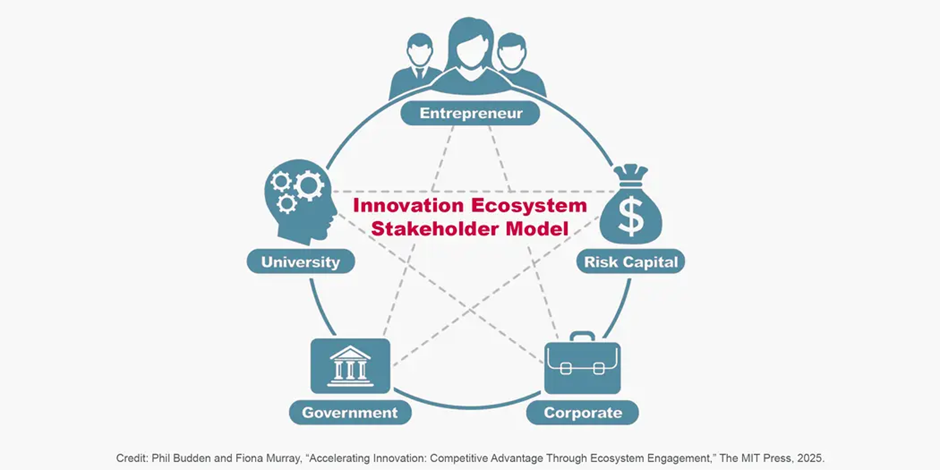 Why Some Ecosystems Thrive, and Others Don't
A fully stocked ecosystem is good, but not the same thing as a functioning one. Having all the right players in place means little if they are not aligned. Without alignment, even well-resourced ecosystems underperform.
⚠ When It Fails — Allianz
The insurance company Allianz has an ecosystem that invests "primarily from a financial perspective," focusing on external start-ups. Although this initially saves costs, it means Allianz is unable to achieve synergy — isolated innovations and investments are unable to cross-pollinate.
In turn, this creates rising coordination costs, greater waste, and stalled momentum.
✓ When It Works — Edinburgh
The Data-Driven Innovation initiative from the University of Edinburgh ensures that "collaboration isn't left to chance" — its six innovation hubs are structured and located alongside one another, facilitating "water cooler" exchanges that lead to real collaboration.
Much smaller ecosystems regularly outperform larger ones simply because of alignment that ensures coordination.
Similarly, Walmart failed to compete with Amazon when Walmart Labs "lacked distinct strategic value." Only limited innovations were supported, meaning any outcomes were rarely "valuable or aligned with Walmart's broader business strategy."
The Missing Piece: The ConnectorFor an ecosystem to create alignment, a key player needs to be introduced: the interlocutor or connector that bridges all the other key entities together and unites them in goal and purpose. Their foundation is built on trust — which allows different actors to rely on each other, imbuing the ecosystem with predictability, transparency, and credibility. Without it, collaboration is performative. With it, collaboration becomes structural.
The role of the connector should be played by leadership in the form of national innovation agencies, large corporations, or strategic advisory organisations that have the ability to navigate and bridge the different sectors of the ecosystem, bringing policy, industry and innovation together.
Consider a university research lab that has spent three years developing a low-cost desalination technology. The science is proven. Yet the researchers have never spoken to a procurement officer, a water utility, or a sovereign wealth fund. A strategic advisory organisation, already connected to these different actors, can facilitate the introductions. Soon, the lab has a pilot program funded and ready to scale. Without that connecting force, a proven innovation never leaves the lab.
Serving as the connective tissue, leadership can bridge different sectors — such as universities and industry — building a shared vision that can be translated into action. By acting as this bridge, the connector unlocks momentum. In their absence, even well-funded ecosystems can remain fragmented and unable to reach their potential.
A Call to LeadersAs leaders, we must identify our place in the ecosystem and how we can help build collaboration where it is missing and required. When looking to innovate, the focus should shift from being participants in innovation to orchestrators of the broader ecosystem, capitalising on synergies and associations to incubate meaningful outcomes.
The focus should be on acting as the bridge between the different players of innovation, creating strategic alignment between research, capital, policy, and industry.
Reflection Questions for Your Ecosystem
- Are the right actors connected within your ecosystem?
- Are you creating the necessary bridges between research, capital, policy, and industry?
- How are you enabling meaningful connections within your organisation?
- Are you a participant in innovation — or an orchestrator of the broader ecosystem?
Sources Related InsightsReady to bridge your innovation ecosystem?
Let's discuss how Bridge X Advisory can support your growth strategy.
Bridge What's Next